Creamer Media’s Engineering News Online
Advanced Search


We have detected that the browser you are using is no longer supported. As a result, some content may not display correctly.
We suggest that you upgrade to the latest version of any of the following browsers:
         
close notification
powered by
GOLD 1735.38 $/ozChange: 1.72
PLATINUM 1663.00 $/ozChange: 5.00
R/$ exchange 7.55Change: 0.01
R/€ exchange 10.03Change: 0.00
 
LOW-CARBON TECHNOLOGY
Cleantech investments experiencing strong growth
 
14th October 2009
TEXT SIZE
Text Smaller Disabled Text Bigger
 

The ‘cleantech', or low-carbon technology sector, was the fastest growing among venture capital sectors, and experienced 1 000% growth between 2000 and 2007, making it the third venture capital sector in size, after information and communications technology and biotechnology.

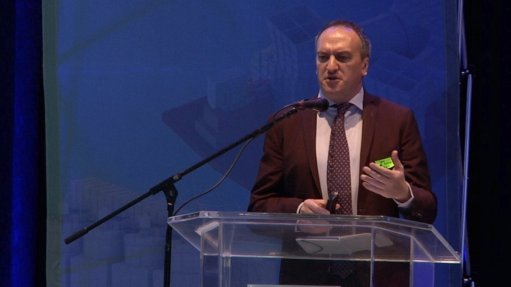
In addition, noted World Wide Fund for Nature trade and investment adviser Peet du Plooy, at a cost of €400-billion, the North African Desertec mega-grid solar project, was the world's largest ever engineering project.

Speaking at the third and final day of the World Solar congress in Johannesburg, Du Plooy also noted that the "low-carbon reindustrialisation" of the world, which he stated was only a matter of time, could come at a cost of some $40-trillion over the next 25 years.

In 2007, clean energy investment worldwide was said to have totalled $148,4-billion, which represented about 1% of global fixed asset investment, and 19% of global energy infrastructure investment. The United Nations Environment Programme forecast that this figure would reach $450-billion a year in 2012.

Hamburg-based Max Planck institute for meteorology director Hartmut Grabl stated that the twenty-first century challenge was that mankind needed to double its energy requirement, while lowering emissions and the rate of climate change. The consequence of this, he said, was a "total renewal of energy supply systems".

In this regard, he added that "if there is no real policy making, we will have a very big problem very soon".

Du Plooy further noted, that even in the financial crisis period of 2008, renewable energy showed growth of 16%, whereas world oil use declined. He also added that while growth in 2009 would be slower, a faster recovery was expected for renewable energy than almost any other sector.

With this amount of investment, the generation of so-called ‘green jobs' was also an important, and currently some 2,3-million jobs had been created in the renewable energy sector alone. The expectations for 2030 exceeded eight-million jobs created through the solar and wind power industries alone.

Du Plooy emphasised that green jobs in South Africa were not limited to those created through renewable energy and water treatment, but extended to initiatives such as working for water, which cleared alien invasive vegetation; recycling; sustainable transport such as the Gautrain and potential opportunities for vehicles powered by alternative energy.

Solar energy is essentially infinite, distributed, modular and fit-for-purpose, which meant that "we could cut out the million year old middle man" that is coal, Du Plooy quipped.

Meanwhile, he compared renewable energy with a conventional coal-fired power station such as Eskom's new-build Kusile station, stating that while Kusile would experience rising fuel costs, solar power had no fuel cost. If carbon taxes were introduced, Kusile would face an economic risk of having to pay for emissions, while solar power on the other hand could generate carbon revenue through certified emission reductions.

Coal-fired plants could service grid-connected customers only, while solar power could energise, through heat and electricity, customers who may never have benefited from conventional grid connection. Coal mines impacted water supplies, air quality and tourism potential, while solar power could stimulate rural development and enhance tourist attractions, added Du Plooy.

He further highlighted that one new-build coal fired power station built in South Africa, would emit more greenhouse gas that the 20 least emistting African countries combined.

Du Plooy also said that if a carbon price were set at R200/t of carbon dioxide equivalent emission, Eskom's carbon payments required would exceed the company's turnover and Sasol's profit would be reduced by some R14-billion.

Currently, South Africa's share of global greenhouse gas emissions stood at 1,16%.


Edited by: Creamer Media Reporter
FULL Access to Mining Weekly and Engineering News - Subscribe Now!
Subscribe Now Login


Hide Comments  
 
This article contains no Comments


All comments must be approved by our editors, click here to read the editorial guidelines for comments. Please allow some time for our editors to approve your comment after posting.
 * Required Fields

image
image
 *


image
image
 *
 

image
image
 

Verification Image

image
image
 * Please enter the text you see in the above image.