Creamer Media’s Engineering News Online
Advanced Search


We have detected that the browser you are using is no longer supported. As a result, some content may not display correctly.
We suggest that you upgrade to the latest version of any of the following browsers:
         
close notification
powered by
GOLD 1568.25 $/ozChange: -23.56
PLATINUM 1445.50 $/ozChange: -14.00
R/$ exchange 8.33Change: 0.00
R/€ exchange 10.57Change: 0.07
 
Corporate Responsibility
Carmaker teams up with forestry group on carbon-offset scheme
 
26th September 2008
TEXT SIZE
Text Smaller Disabled Text Bigger
 

Paper giant Sappi has teamed up with Volvo Car South Africa to promote the planting of indigenous trees by local communities and schools.

Linking with Sappi’s Sandisa Imvelo (Growing Nature) programme for planting indigenous trees, the two companies have launched the GreenForBlue project, an incentive for every Volvo buyer to minimise the effects of carbon dioxide (CO2) emissions from the Volvos they drive by having a number of indigenous trees planted to offset the CO2 that will be emitted.

Through the Sappi Sandisa Imvelo programmer, a number of areas suitable for the planting of indigenous trees, such as the seam between commercial forests and public roads, and other pockets of land, have been identified on Sappi land, in KwaZulu-Natal and Mpumalanga. During each planting season, Sappi will plant at least 10 000 trees, which will be sourced from the Wildlands Conservation Trust’s Indigenous Trees for Life project.

The project is expected to contribute to the worldwide effort to curb global warming, increase the biodiversity on land owned and cultivated by Sappi and ensure a healthier environment.

The aim is to use the trees’ natural process of photosynthesis and conversion of CO2 into wood material to minimise the negative effects of vehicle emissions.

Sappi group head of corporate affairs André Oberholzer says that as trees grow, they mitigate the effects of climate change by removing carbon from the atmosphere in a process known as carbon sequestration, which is then stored as biomass.

“By planting enough indigenous trees per car sold, Volvo is making a meaningful contribution to climate change mitigation. Planting the trees on Sappi property ensures that they are properly cared for and contribute substantively to conserving and, indeed, increasing South Africa’s biodiversity,” says Oberholzer.

Sappi MD Hendrik De Jongh says: “Plantation-based forestry sequesters CO2, helps combat the greenhouse effect and is carbon neutral in the total value chain. “There are opportunities for green energy to abound in the industry by using the available forestry biomass.”  

Sappi has identified a number of suitable areas where indigenous trees can be planted. Almost a third of all land owned by Sappi is not under timber crops and managed as conservation areas. Pockets of land near roadsides and between plantations will also be used to ensure maximum impact.

Oberholzer points out that, while indigenous forests in South Africa cover less than 1% of the land area, indigenous trees represent an extraordinary wealth of biodiversity.

“South Africa has over 1 100 indigenous tree species compared with Europe, with fewer than 100 indigenous tree species. Sandisa Imvelo creates a focused approach to enhancing and appreciating our green heritage.”

Sappi has calculated that, on average, one tree will offset or convert about 18 kg of CO2 each year. The average production of CO2 by a Volvo XC90 over 100 000 km (on average five years’ driving) is 26 600 kg. This requires 15 trees to be planted and grown for 100 years to capture the CO2 produced by an XC90 over 100 000 km.

Volvo Car South Africa media affairs manager Deon Sonneku says that, globally, Volvo Car contributes to the offsetting of CO2 emissions by funding the United Nations’ certified climate-neutral projects, such as renewable energy production in China and India.

“This is achieved by including a climate compensation for every 45 000 km of motor- ing in a Volvo FlexiFuel car. In a car run entirely on E85 fuel (a blend of 85% bioethanol and 15% petrol, which is widely available in Sweden), the only fossil-fuel carbon emissions are caused by the petrol component of the fuel and the production and distribution of its bioethanol component,” says Sonneku.

The equivalent figures for the rest of the Volvo Cars model range are; Volvo C30 (11 trees), Volvo S40 and V50 (11 trees), Volvo S60 (11 trees), Volvo S80 (14 trees), Volvo C70 (11 trees) and Volvo XC70 (13 trees).

Volvo Car South Africa and Sappi will create an incentive for every buyer of a Volvo to make a contribution by sponsoring the planting of the relevant number of trees to neutralise the carbon emissions that the vehicle would produce over 100 000 km.

Edited by: Martin Zhuwakinyu

To subscribe to Engineering News's print magazine email subscriptions@creamermedia.co.za or buy now.

FULL Access to Mining Weekly and Engineering News - Subscribe Now!
Subscribe Now Login


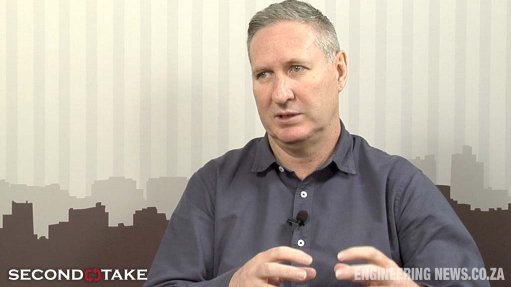
Sappi MD Hendrik de Jongh discussing the importance of GreenForBlue project. (17.09.2008) Cameraperson: Danie de Beer. Editing: Darlene Creamer.
This video is licensed under a Creative Commons License
GET SELECTED VIDEO
Embed
Selected Video Download (7.93mb)