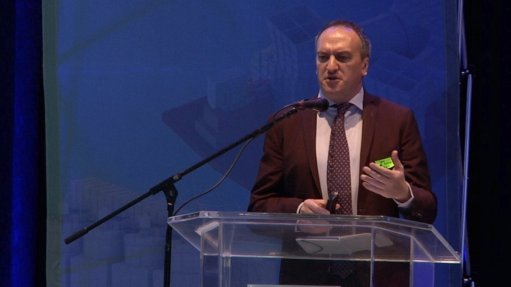
South Africa needs to embrace the respon- sibilities that come with the freedom and the rights it gained when the country became a democracy in 1994 and produce leaders who will not conform to dominant paradigms, but rather lead according to what society needs, says Albert Luthuli Centre for Responsible Leadership director Professor Derick de Jongh.
He emphasises that South Africans need to take their responsibilities seriously by holding leaders accountable for their actions.
“Every single member of society, not just government, has to take responsibility for dealing with the freedom gained when South Africa became a democratic society. We need to look at each other and ask: what is needed to build this country?
“We love to criticise private and public leaders and, therefore, don’t focus on the important issues. South Africans need to develop a collective and collaborative understanding of the kind of leaders we need across all the sectors and to develop the next generation of leaders to tackle the issues at hand, instead of pointing fingers and making accusations,” states De Jongh.
He believes the voice of South Africa’s civil society is weak.
“When we were fighting against apartheid, civil society was not only powerful but was also supported internationally by various campaigns and movements.
“Civil unrest brought South Africa’s apartheid system to its knees. Now it seems as if South Africans do not have a strong enough cause to fight for and, instead, are fighting each other and blaming race for every challenge we face,” he states.
De Jongh warns that time is running out for South Africans to adapt to the responsibility of strengthening their newfound democracy.
“We need to face the challenges in our country and stop playing political games,” he adds, reflecting on President Jacob Zuma’s comments on the Limpopo textbook scandal during an interview with Talk Radio 702 presenter Redi Tlhabi on July 23.
The Department of Basic Education failed to deliver textbooks for school learners in Limpopo.
Zuma told Tlhabi that Basic Education Minister Angie Motshekga could not be held accountable for the Limpopo textbook scandal, noting that the education problems in Limpopo were, rather, rooted in apartheid.
“What is happening today is what [former Prime Minister Hendrik] Verwoerd did, where the black majority were historically not given an education,” he added.
Many people have called for the resignation of Motshekga and Limpopo Education MEC Dickson Masemola.
De Jongh, however, highlights that public and private leaders who have responsibilities and fail to live up to them, should be held accountable and civil society needs to ensure that accountability.
He notes that the biggest challenge South Africa has to overcome is in developing the next generation of public and business leaders.
“Business schools have a big role to play in this,” he adds.
“Some business schools are still developing leaders who will maximise the dominant economic paradigm, instead of developing well-balanced leaders who will uphold the best interests of society,” De Jongh states.
The ideological interests of political parties and private companies seem to receive more emphasis than the pressing societal issues, which may not be in the best interest of the country as a whole, he adds.
Businesses mainly operate within the economic paradigm, says De Jongh. “There is a fundamental need for business schools to ask whether everything they are teaching students is still relevant to what we as a country need today.”
Business schools, therefore, need to produce leaders who can find a balance between making a profit and serving the greater good – leaders who can look beyond purely economic motives to what success and progress actually means, the centre states.
A shift from the economic paradigm towards social and environmental responsibility, as well as good corporate governance, needs to occur in the public and the private sectors, De Jongh emphasises.
To address global leadership issues, the University of Pretoria-based Albert Luthuli Centre for Responsible Leadership in 2010 collaborated with business schools worldwide, investigating a more radical vision for management education.
This resulted in the formation of the 50+20 initiative, which was presented at the Rio+20 Earth Summit 2012, held in Rio de Janeiro, in Brazil, where 50+20 argued for a global mind shift away from the current management-education perspective.
“We are looking critically at what we are teaching Master of Business Administration graduates and whether it is still relevant in light of current global challenges,” De Jongh states.
In addition, the Albert Luthuli Centre for Responsible Leadership offers a leadership development intervention called the Respon- sible Leadership programme, which encourages courageous conversations in driving collaborative action in support of social and environmental justice.
“Programme participants are highly talented individuals working in the public, private and civil society,” the centre explains.
The Responsible Leadership programme will be presented over two days in partnership with software developer Microsoft South Africa, The Gordon Institute of Business Science and the Albert Luthuli Centre for Responsible Leadership.
“This course is the first of its kind in South Africa with the first intake of participants from October 18.
With this programme, we aim to develop alternatives to the current economic paradigm and find solutions in assisting to produce responsible, well-balanced leaders for the future of South Africa,” says De Jongh.
To subscribe to Engineering News's print magazine email subscriptions@creamermedia.co.za or buy now.