Creamer Media’s Engineering News Online
Advanced Search


We have detected that the browser you are using is no longer supported. As a result, some content may not display correctly.
We suggest that you upgrade to the latest version of any of the following browsers:
         
close notification
powered by
GOLD 1386.60 $/ozChange: -0.70
PLATINUM 1452.50 $/ozChange: -1.00
R/$ exchange 9.58Change: -0.03
R/€ exchange 12.38Change: -0.05
 
TRANSPORT FUELS
 
BP economist questions economic logic of new SA refinery
 
6th March 2012
TEXT SIZE
Text Smaller Disabled Text Bigger
 

BP chief economist Christof Ruehl has questioned the economic logic of South Africa’s plan to build a new crude oil refinery, saying that such a development would go against two key global trends: the prevailing surplus of refining capacity and the expansion of the international trade in liquid fuels.

South Africa’s national oil company PetroSA has proposed the development of a R200-billion, 360 000 bl/d refinery, dubbed Project Mthombo, for development in the Eastern Cape. However, it emerged recently that a feasibility study is under way for a smaller-sized refinery.

In light of recent inland stock shortages, the Department of Energy (DoE) had also initiated an audit of South Africa’s refineries to determine the “real status” of their production capacities and capabilities.

The audit would inform a 20-year infrastructure road map, which would be completed by year-end. This document would determine the need for expansion programmes, including the need for Mthombo.

The DoE indicated that the plan would encourage investment, as well as a move towards cleaner fuels. In the absence of significant new investment in local refining capacity, it had been calculated that South Africa would be importing about 8.5-billion litres of fuel a year, or 150 000 bbl/d, by 2015.

But speaking in Johannesburg during a visit to South Africa, Ruehl said global refinery throughputs were likely to grow only modestly over the coming 20 years, notwithstanding BP’s projection that liquid fuels consumption would expand by 16-million barrels a day, to 103-million barrels a day, by 2030

Refinery demand would, in BPs view, expand by only 9-million barrels a day over the coming 20 years, constrained by the growth in fuels that did not require refining, such as biofuels and nonrefined natural gas liquids. In addition, existing spare capacity would accommodate some of the future growth in refinery throughput, while China’s stated strategy of refined product self-sufficiency could curtail increases for refiners outside of China.

In such a context, Ruehl questioned the advisability of pursuing a new refinery investment in South Africa, which could result in South African taxpayers subsidising consumers elsewhere.

“If you have a new refinery in the current environment and it is not fully utilised, as it is likely to be, you have to either join the forces of the market which would say, ‘close the thing’ . . . or you get into a situation . . . where you need government support to keep it open,” he argued.

In the South African context, a new refinery would probably need to fill a growing demand for diesel, but the refinery would produce both petrol and diesel, which could result in a surplus of petrol. “If you do that with subsidies, which is suspiciously how it looks, then those who buy it somewhere else would thank you . . . at the expense of the South African taxpayer.

The focus of policymakers should rather be on understanding what infrastructure backlogs and bottlenecks existed to prevent the surplus of refined product available globally from reaching the South African market.

“The international global trends fly right in the face of building a refinery right now. Then you have to ask whether there are any exceptional reasons for South Africa to build it – the generation of employment, development of the region, or being completely cut off from rest of the world. In my view, as far as I can see, the answer is it doesn’t make sense from an economic perspective.”

But BP Southern Africa CEO Gerard Derbesy insisted that the global group remained committed to investing in South Africa. It was particularly committed to upgrading its terminals, as well as modernising the Sapref refinery, in line with South Africa’s cleaner-fuels requirements. BP and Shell jointly own Sapref, which is based in Durban.

The introduction of new fuel standards could require the country’s top refineries to invest up to $4-billion in upgrading their plants.
 

Edited by: Creamer Media Reporter


To subscribe to Engineering News's print magazine email subscriptions@creamermedia.co.za or buy now.

FULL Access to Mining Weekly and Engineering News - Subscribe Now!
Subscribe Now Login


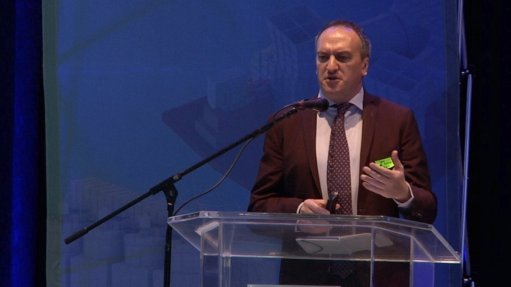
BP chief economist Christof Ruehl questioning the economic logic of South Africa’s plan to build a new crude oil refinery. Camera Work: Nicholas Boyd. Editing: Darlene Creamer.
This video is licensed under a Creative Commons License
GET SELECTED VIDEO
Embed
Selected Video Download (10.22mb)
 
BP chief economist Christof Rueh
 
Picture by: Duane Daws
BP chief economist Christof Rueh
 
BP Southern Africa CEO Gerard Derbesy
 
Picture by: Duane Daws
BP Southern Africa CEO Gerard Derbesy
 
 
Previous Play Next