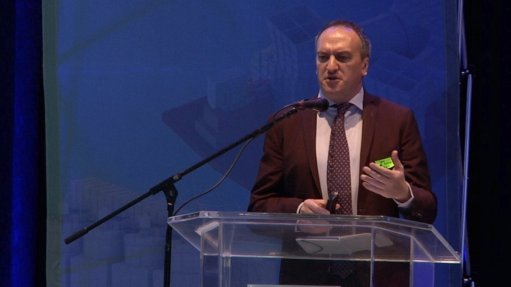
The aviation industry has never been in a more difficult situation, and with $80,8-billion expected to be missing on the bottom line this year as a result of the economic downturn, the industry could not afford to pay for duplication of security systems, International Air Transport Association (Iata) senior vice-president of safety operations and infrastructure Guenther Matschnigg said in Cape Town on Tuesday.
Speaking at the Avsec World 2009 conference, he pointed out that the industry was spending about $5,9-billion a year on security measures, trying to “protect ourselves from improbable threats”.
The industry had to eliminate ineffective and costly duplication of aviation security procedures, which only created the illusion of security, he said.
Director-general of civil aviation in Denmark Kurt Lykstof Larsen added that it was impossible to eliminate security threats 100%, but said that airlines could diminish threats to acceptable levels.
Larsen added that cost of security measures in some regions of the world were too high, saying that this equated to about 35% of the total operational costs of some airlines.
The airline industry had to set up a one-stop security system and identify and eliminate duplication, urged Matschnigg, noting that the current global economic crisis provided the ideal opportunity for the industry to change the way it handles its security.
The industry would, however, not shift its focus away from security, but had to work smarter to achieve more with limited resources.
Larsen stated that proper security risk assessment measures were needed by the industry to ensure that the limited resources were allocated to the right areas, where it could be the most effective.
He added that the limited security resources were currently being spent equally on all passengers, including low-risk passengers and bags, instead of just high-risk passengers and bags.
While profiling to distinguish between low-risk and high-risk passengers was difficult, there was also hesitation from a political point of view to impose such measures, said Larsen.
Further, Larsen also pointed out that the public were also often unwilling to accept new screening measures that would simplify and speed up the security processes.
Matschnigg and Larsen also highlighted that governments often implemented additional aviation security legislation, with the smallest new security legislation often leading to substantial additional costs for the airline industry.
Governments had to work with the industry and involve all stakeholders when trying to develop new regulations, said Larsen.
Further, a number of legislative or regulatory measures were no longer as effective as when first implemented, said Larsen, noting that defence measures could not be static, but had to be constantly re-evaluated.
Meanwhile, Iata and the Aviation Security Executive Group have developed a security strategy, based on five criteria, which it believed would result in effective and appropriate security measures for the industry.
Firstly, the industry had to adopt a threat-based and risk-managed approach to security by using systems-based measures, such as the Security Management System developed by Iata.
Regulators should, secondly, work with the industry and airline operators on outcome-based legislation, rather than working in isolation.
Airlines and regulators further had to manage their relationships and share their perspectives, knowledge and experience of operational impact to the development and evolution of regulations.
Innovation and technology was a further key requirement, with Matschnigg saying that technology had to be brought out of the laboratories and into the industry.
Lastly, the industry had to implement cost-effective and efficient security measures that were judged in terms of added value, proportionality and common sense. Iata said that this would foster decision-making based on data and sound threat analysis, instead of fear and improbability.
To subscribe to Engineering News's print magazine email subscriptions@creamermedia.co.za or buy now.