Creamer Media’s Engineering News Online
Advanced Search


We have detected that the browser you are using is no longer supported. As a result, some content may not display correctly.
We suggest that you upgrade to the latest version of any of the following browsers:
         
close notification
powered by
GOLD 1731.95 $/ozChange: -4.82
PLATINUM 1665.00 $/ozChange: 19.00
R/$ exchange 7.58Change: -0.03
R/€ exchange 10.04Change: -0.12
 
Automated renewable energy sources power farmhouse
 
11th June 2010
TEXT SIZE
Text Smaller Disabled Text Bigger
 

Global warming and carbon dioxide reduction advocacy group Beacon Energy has set up a farm to demonstrate renewable-energy sources.

The farm, which is almost independent of the national grid and fossil fuels, has interlinked wind turbines, photovoltaic panels and two water-powered generators that each feed energy into a common dc bus through ac drives, which also feed single- and three-phase electricity needs, says Loughborough University PhD research student Matthew Little.

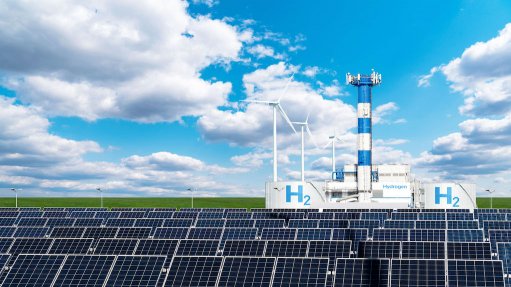
Little, who was closely involved in the development of the farm alongside auto- mation specialist company Control Techniques, says that the renewable- energy sources are supported by a hydrogen energy storage system with an electrolyser, storage tanks and two fuel cells, a propane combined heat and power unit and solar water heaters and a ground source heat pump. Further energy storage is provided by a high-energy density 20-kWh battery at 620 V.

The hydrogen energy storage system uses an alkaline electrolyser that pro- duces hydrogen stored at 137 bar, provid- ing 4 kWh of energy. The hydrogen is then used in the two-proton exchange membrane fuel cells that together produce 7 kW of power that is fed into the dc bus through power converters.

The system has two main functions, namely to maintain the dc voltage in the local grid and to export excess gen- erated power to the national grid.

“A 37-kW Unidrive SP works in four-quadrant mode and is the only link to the national electricity supply. “In practice, we use virtually no national grid power and the link to the grid is there to export power and just in case we need it,” says Little.

Control Techniques supplied and installed the Unidrive SPs, which it used in the automation of the farm, because of their versatility. A particular mix of features, on-board programming, high-speed communication and four-quadrant control, was needed to integrate the various systems, says Control Techniques South African subsidiary Emerson media liaison Bianca Botha.

“The Unidrive SP is fitted with a programmable application module for on- board programming and CT-Net high- speed networking for data collection and diagnostics. “Data is fed into LabView, which inter- faces with CT-Net and monitors every aspect of the system, helping to analyse the effectiveness of the different technologies,” says Botha.

Two wind turbines drive 25 kW at the 415-V three-phase induction generators that feed power to the dc bus through 30-kW ac drives. At a predetermined generator speed, the drives synchronise and connect (catching a spinning motor/generator), set the motoring current to zero and start to generate power at 50 Hz, feeding dc power to the bus. If, after a time, the turbines are not generating power, the drives close down again. Four solar arrays contribute a further 6 kW at 120 V and the combined heat and power rig adds another 15 kW, as well as providing 38 kW of heating for the farmhouse, says Little.

A reverse-osmosis rig filters rainwater for the house and electrolyser. The heat pump, which extracts heat from a nearby lake, supplies heat to the house. The Unidrive SPs also control pumps for the water supplies to the house, the hangar and the fire prevention system, and other drives provide power for the winch and general amenities that are located nearby the wind turbines, concludes Little.

FULL Access to Mining Weekly and Engineering News - Subscribe Now!
Subscribe Now Login


Hide Comments  
 
This article contains no Comments


All comments must be approved by our editors, click here to read the editorial guidelines for comments. Please allow some time for our editors to approve your comment after posting.
 * Required Fields

image
image
 *


image
image
 *
 

image
image
 

Verification Image

image
image
 * Please enter the text you see in the above image.


Facts
4 kWh The amount of energy provided by the hydrogen energy storage system that uses an alkaline electrolyser at 137 bar