Creamer Media’s Engineering News Online
Magazine in Store Now!
Advanced Search
 
 
powered by
GOLD 1107.65 $/ozChange: -5.85
PLATINUM 1586.50 $/ozChange: -8.50
R/$ exchange 7.46Change: -0.04
R/€ exchange 10.17Change: -0.05
 
 
2010 FIFA WORLD CUP
An inside look at the countdown to South Africa’s biggest-ever broadcast event
0 COMMENTS  |  
ADD A COMMENT PRINT
 
 
27th November 2009
TEXT SIZE
Text Smaller Disabled Text Bigger
 

South Africa has made significant investments into its information and communication technology (ICT) infrastructure in a bid to meet commitments, guaranteed by the Department of Communications, as part of the country’s hosting of the 2010 FIFA World Cup.

These guarantees cover the provision of connections between Telkom’s public telecommunications exchanges and the ten stadiums, as well as the high-technology International Broadcast Centre (IBC), in Johannesburg.

Situated at the Expo Centre, in Nasrec, in Soweto, the IBC will be the nerve centre for all television operations and the news agencies of the world during the World Cup to transmit the tournament across the globe to thousands of viewers using high-definition television and the latest broadcasting technologies.

The City of Johannesburg has invested about R120-million for the construction of the IBC, mainly to rent and upgrade the required halls and facilities at the expo centre. Further, the City of Johannesburg will provide various services relating to electricity installation, security and monitoring, waste removal, health and transport. Included in the high-tech facilities that will be constructed at the IBC are satellite teleport and telecommunications infrastructure.

The IBC itself is expected to create 3 370 jobs, while its contribution to the city’s gross domestic product (GDP) is expected to be R340,9-million in direct expenditure, R513,7-million in indirect and induced expenditure and R58,3-million in taxes, a socioeconomic study conducted by Grant Thornton states.

But the main aim is to deliver a high-quality broadcast experience for football lovers the world over and a world-class experience for the sports broadcasters.

Over the past 15 years, the ICT sector has contributed close to 7% of South Africa’s GDP, but BMI-Techknowledge reports that, in recent years, much of the focus has been on projects associated with the 2010 FIFA World Cup.

In fact, in a paper entitled ‘SA ICT Government Spending Trends’, the market research company asserts that this focus has resulted in other ICT projects being placed on the back burner. It expects government to shift its focus back to these pressing ICT-related projects once the hype of the soccer event is over.

The Show Must Go On
Only time will tell whether the attention given to the football showcase will pay dividends. But there is also little question that government is leaving nothing to chance, realising that the broadcast experience is likely to be as important to the image of the country as the physical infrastructure itself and the pleasant match-day experience of spectators and supporters.

Every ICT system will be duplicated on match days to ensure that there are no hiccups in broadcasting the tournament to the world, 2010 FIFA World Cup Local Organising Committee chief IT and telecoms officer Phumlani Moholi tells Engineering News.

“All the ICT systems will be monitored and the IBC will operate like a military command unit,” he states.

The command centre for the dry run of the Confederations Cup was far smaller, as there were only 16 matches compared with the 64 matches of the World Cup.

“As a country, we cannot afford to drop the ball, and there can be no comebacks,” Moholi warns.

The IBC will be linked to all ten match venues and redundancy (backup capacity) will be built into the system by Telkom, which will also establish ‘media tribunes’ to enable journalists to send out pictures requiring high-speed bandwidth.

“The show must go on,” he says.

The 30 000-m2 IBC is the gateway to international video and audio circuits and the State Information Technology Agency will provide customised spaces for broadcasters.

Moholi says an essential element of the system is power because, if it fails, there will be no show.

“A backup power generation system will, therefore, be established as an alternative to Eskom power to ensure that broadcasting will not be interrupted,” he said.

“Local backup generators will also be used in the event of a failure of the electricity supply.”

Vital Statistics
The 2006 FIFA World Cup was broadcast to 214 countries and territories on 376 channels, with a total coverage of 73 072 hours.
The global cumulative television audience was 26,3-billion, with 24,2-billion home viewers and 2,1-billion watching out of home.

For the 2010 FIFA World Cup, FIFA expects a similar worldwide television audience – with record viewing across Africa. Media traffic over broadband Internet and mobile is expected to go up dramatically.

In 2007, the world football governing body began innovations in television with a shake-up of its television strategy. The television division successfully managed to have all broadcast activities performed in-house, ranging from the actual sale of rights, the development of a comprehensive in-house footage archive (FIFA Films) to client servicing and the overall event operation.

This approach was evident in the build-up to the World Cup, in particular in the three key events staged on the African continent – the FlFA Confederations Cup, in South Africa, the FIFA U20 World Cup, in Egypt, and the FIFA U17 World Cup, in Nigeria.

Host Broadcast Services (HBS), a Switzerland-based company owned by Infront Sports & Media, is in charge of organising the broadcast operations and infrastructure. Its role also includes producing and transmitting the international audio and video signals as well as providing the necessary services and facilities for rights holders and licensees to enable them to fulfil their production needs in line with FIFA guidelines.

HBS’s role includes every aspect of the production of the multilateral signal as well as providing the necessary services in order to fulfil their unilateral production needs. This includes the design, construction and set-up of the IBC.

The task involves ten stadiums in nine host cities and the IBC. Delivering the entire operation will involve over 2 000 staff from 50 countries – more than 1 000 will be employed locally in South Africa and more than 350 interns will benefit from a significant investment in training.

FIFA will spend about $150-million on television production and has already placed all the television rights for the tournament across the globe, with Africa, Europe, North America, South America and Asia extensively covered. In keeping with FIFA policy, a large proportion of matches are available on free-to-air television. There are still a few markets where the broadcaster is not known although the overall placement of rights has been completed.

For the first time, FIFA has been able to focus on delivery of the rights and on developing its relationship with the broadcast community. By the time the FIFA World Cup starts, it is envisaged the rights will have been placed in over 200 countries and terri- tories. Internet rights are generally placed with the television rights holder in the respective territories.

The Backbone
Telkom Enterprise Markets acting senior managing executive Thami Magazi says the group is increasingly confident of its ability to deliver, especially given the experience gained during the June 2009 Confederations Cup.

He says the Confederations Cup saw 100% broadcast efficiencies enabled by the backbone ICT infrastructure provided by the JSE-listed entity.

“Despite our achievements, we are carefully dissecting how we could perform with greater efficiency and effectiveness for the final draw that takes place on December 4 in Cape Town – and the 2010 tournament itself,” he states.

FIFA’s requirements from Telkom include an end-to-end telecommunications network, which has high-speed bandwidth and should be a managed network.

The managed network is required to provide 20 Gb of redundancy bandwidth and the network has to be available 99,99% of the time, especially during matches. It must not have a single point of failure and must have dual homing.
The South African government mandated Telkom as a player to install the national network and ensure that the FIFA requirements are met. For a network of that nature, government is spending about R950-million.

Magazi tells Engineering News that, in its master plan, Telkom had its own plans to roll out an entire wide-area network, involving expenditure of R30-billion over a five-year period on a new-generation, state-of-the-art network to enable and provide rich services, such as high-definition video and high-speed Internet.

“We have been investing in this programme [as part of] our normal day-to-day function to address our customers’ infrastructural needs. What the World Cup has done is that it has helped in fast-tracking Telkom’s roll-out, such as the core of the network, by 12 to 18 months,” affirms Magazi.

He adds that Telkom completed four stadiums for the FIFA Confederations Cup, and the remaining six stadiums are on track.

“We needed to haul [optic] fibre to the different venues and our fibre is sitting outside the perimeter of the stadium, less than 1 km away, and as soon as the construction phase is complete, we will move in and take over the rooms that we will use in the different venues”.

Magazi reiterates that he is not overly concerned in terms of the tight deadlines, adding that Telkom is busy testing the fibre at the Peter Mokaba stadium and the Mbombela stadium to ensure that signals can be transmitted without any deterioration.

He notes that the country will not ordinarily need such high-capacity infrastructure in these venues, as it uses satellite, not terrestrial broadcasting.

“I am hoping that, beyond 2010, broad- casters will find value and opportunity in using terrestrial infrastructure for broadcasting. The Department of Communication is looking at this as a legacy issue.”

At the IBC, Telkom will bring in the feed to be able to support HBS and is using two main vendors.

“We are running a Cisco-based network and using a lot of Siemens network on a technology called DWDM (dense wavelength division multiplexing) that allows for a high bandwidth.”

Satellite Link
Meanwhile, State-owned signal carrier Sentech will provide a backup satellite link to the optic fibre provided by Telkom. A backup broadcast link, using satellite, will also be available from each of the ten stadiums to the IBC.

“We aim to have an antenna and a container at each venue to house all the electronic equipment,” explains Sentech VSAT engineer Polloko Rasello.


“We are busy with the finalisa- tion of the final six containers for the World Cup and have five containers that were used during the Confederations Cup. Before the end of this month, all the con- tainers and the electronic equipment will be ready. We are finalis- ing the procurement of the satellite antennas on site and plan to have 4,8-m satellite dishes at each venue for the uplink and a 7,3-m dish at the IBC for the downlink. Four 4,8-m dishes were ordered for the Confederations Cup and we are waiting for another five 4,8-m dishes,” Rasello adds.

The 7,3-m dish also used for the Confederations Cup will be dismantled and moved from Ellis Park to Soccer City.

But Sentech cannot move onto site until the stadiums are handed over to FIFA, and
Sentech broadcasting projects head Etienne Nduli says that it will only consider the project half completed until it can move the base of the satellite dish onto site.

“The fact that we cannot move into the stadiums until they have been handed over to FIFA has impacted on the timelines for when we planned to have the plinths and satellite bases constructed and start planning for the backup satellite link roll-out,” states Nduli.

Rasello notes inspections will clarify Sentech’s locations and whether those locations will allow access to the satellite.

“The plan is to broadcast the World Cup on Intelsat IS 704.”

Sentech’s first challenge was that FIFA wanted 80 Mb/s, but the company operates on 20 Mb/s and needed an encoder that would provide the enhanced Digital Video Broadcasting – Satellite – Second Generation (DVB-S2).

“We struggled to find an encoder that will go to 80 Mb/s as, of all the companies that were trying to supply Sentech with the encoders, only two were able to go above 60 Mb/s. For us to be able to turn the signal around from South Africa to Europe, we had to align our inter-national feed,” reiterates Rasello.

Nduli points out that after 2010, the company will use some of the equipment at its sites throughout the country for other major projects.

Edited by: Martin Zhuwakinyu


Hide Comments  
 
This article contains no Comments


All comments must be approved by our editors, click here to read the editorial guidelines for comments. Please allow some time for our editors to approve your comment after posting.
 * Required Fields

image
image
 *


image
image
 *
 

image
image
 

Verification Image

image
image
 * Please enter the text you see in the above image.


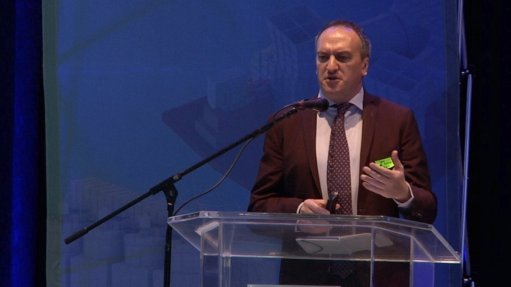
Telkom group executive for multinational customers Thami Magazi discussing how Telkom is making 2010 happen. 27.11.2009. Cameraperson: Nicholas Boyd. Editing: Darlene Creamer.
This video is licensed under a Creative Commons License
 
Previous Play Next