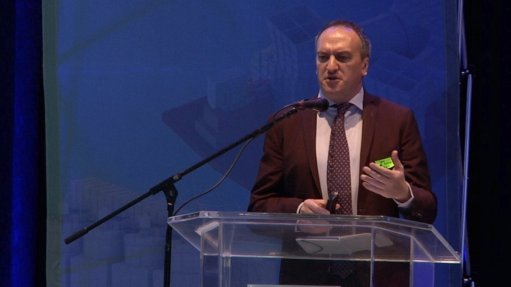
Ekurhuleni executive mayor Mondli Gungubele’s aerotropolis plans seem to be taking flight with the start of a six-month process to develop a strategic roadmap for the Ekurhuleni Aerotropolis project, which will give rise to what he asserts will be Africa’s first so-called 'airport city'.
While investigating the appropriate economic growth path for the city, the Ekurhuleni municipality was exposed to the airport city economy concept and decided to adopt the aerotropolis strategy as its Growth and Development Strategy 2025.
“One-third of the value of international trade comprises goods that are transported by air and, over the next 18 years, the amount of air cargo is expected to triple,” says Gungubele, adding that the municipality aims to capitalise on these developments.
Further, he explains that Ekurhuleni is home to OR Tambo International Airport (ORTIA), which is in contact with the world’s best airline companies and, in terms of size, can only be contested in Africa by the Cairo International Airport, in Egypt.
Through a rail hub in Germiston, the city also connects South Africa and Africa through the Port of Durban, in KwaZulu-Natal, and the Maputo corridor, in Mozambique.
Ekurhuleni also provides interconnectivity through its freeways, such as the N3, R23, R24 and R21, while 1.5-billion kilometres of optic fibre worth R40-million is currently being installed to actualise services.
“Therefore, the basic support infrastructure required to exploit the opportunities of an airport city economy are already in place in Ekurhuleni. However, the existing infrastructure still requires reorientation,” explains Gungubele.
Tackling Choke Points
“A competitive sustainable aerotropolis will be achieved through careful planning principles, which involves the restructuring of the city. To improve economic efficiency and reduce congestion, some business and industry may have to be relocated,” explains the University of North Carolina’s Kenan Institute of Private Enterprise director Professor John Kasarda.
Residential communities also need to be designed to ensure that all the daily services are nearby to limit commuting over long distances, he says.
Kasarda, who is seen as the leading developer of the aerotropolis concept, is developing the Ekurhuleni aerotropolis roadmap, which includes guidelines for the development of infrastructure and facilities, a business plan and implementation strategy.
While overall highway connectivity is good, certain choke points still need to be tackled, with other modes of transportation, such as passenger and freight rail, also needing to be upgraded and synergised.
The municipality is currently in talks with provincial and national government to ensure that Transport Minister Sibusiso Ndebele starts the analysis of the transport infrastructure challenges.
“We might have these developed freeways and a rail hub but are they organised in a manner that enables the airport city to fully exploit these resources?” asks Gungubele.
Ekurhuleni’s growth and development strategy, which is under review and should be completed by the end of this year, together with the aerotropolis roadmap, will also identify the city’s infrastructure needs, in terms of energy, water supply and sanitation.
He says once an aerotropolis strategy of this nature is adopted, interest is created worldwide. Already, a company from India is contemplating the construction of an electronic product factory in Ekurhuleni, as well as an information technology college.
The aerotropolis strategy will suit industries that produce light-industrial and time-critical products, as well as air travel intensive executives and professionals. Boosting tourism is also an important component of the strategy.
He adds that the municipality intends to transform Kempton Park into the cultural capital of Ekurhuleni – and even Gauteng, by establishing a convention centre, museum and theatre, which will help establish Ekurhuleni as a destination of choice.
Aerotropolis Jobs?
An aerotropolis economy creates many job opportunities, as it does not only have the potential to impact a 25 km radius, but a 60 km radius, thereby benefitting the whole of Gauteng.
“The majority of South Africans have been excluded from participating in the economy. Whatever approach we take must consider this factor. Programmes, such as Ekurhuleni’s Township Economy Strategy, have to be developed at a fast pace to provide opportunities for historically disadvantaged communities,” says Gungubele.
The aerotropolis strategy seeks to unleash the vibrancy of the townships by interacting with original entrepreneurs and connecting them with the main value chain along with export opportunities.
“There is no question that millions, which we do not have, will have to be spent to develop the aerotropolis economy. The key, however, is to devise a bankable strategy that involves the public-private sector. We have to create conditions that attract investment and funding of development,” notes Gungubele.
Kasarda says airports will shape business location and urban development in the twenty-first century as much as highways did in the twentieth century, railroads in the nineteenth and seaports in the eighteenth.
He says it could take decades for the full aerotropolis to evolve following this model, however, Ekurhuleni will have much to demonstrate when it hosts the Airport Cities World Conference and Exhibition from April 17 to 19, in 2013.
Kasarda states that Ekurhuleni is well suited to become an aerotropolis economy as it has a leading global hub airport at its centre, which is extensively connected to Asia, Europe, the Middle East, South America and parts of the US.
He was in Ekurhuleni last month to meet government officials and corporate representatives to present the aerotropolis concept, discuss the Ekurhuleni aerotropolis strategic roadmap, as well as the business opportunities presented by an airport city.
“Without the involvement of these stakeholders it would be impossible to develop an aerotropolis, which will enable Ekurhuleni’s business and industry to move towards high-value products that are efficiently shipped through the ORTIA.
The aerotropolis concept will provide Ekurhuleni with greater economic efficiency that will cut costs, increase productivity and expand market reach of businesses in the region.
Meanwhile, using the guidelines of the strategic framework to design the aerotropolis, instead of spontaneous development, will create an area that is also more environmentally and socially sustainable.
Challenges faced by the project include people who create roadblocks to hinder the implementation of the aerotropolis strategy, as they have misunderstood the model and its potential to impact people at all socioeconomic levels, especially those who are at lower levels.
Kasarda says some people also believe airports are damaging to the environment; however, aviation has less impact on the environment than other modes of transport, contributing only 2% to greenhouse gas emissions.
Beyond Ekurhuleni
Besides Ekurhuleni, Kasarda has visited Durban, in KwaZulu-Natal, which also has plans to develop an aerotropolis around the King Shaka International Airport (KSIA), which is north of the city.
“I was impressed with the long-term plan for development at the airport, such as the Dube Tradeport air logistics complex,” says Kasarda.
He adds that the development of an aerotropolis around the KSIA will be a greater challenge than that of Ekurhuleni, as the area does not have the local market size or the air connectivity. Therefore, it will have to develop the needed logistic systems and commercial facilities to grow its economy and aviation routes.
“Durban does have a solid plan that fits the aerotropolis model well, but it will likely take at least two decades for the evolution of a successful aerotropolis.”
However, Kasarda notes that the planners and landowners recognise that the Durban Aerotropolis development will be incremental and therefore have a realistic 20- to 40-year plan to foster aerotropolis development.
“Both the KSIA and the Dube Tradeport are first-class modern facilities that have good prospects to form the core of a Durban aerotropolis. Further, the airport has a vast amount of open land around it for future aviation-linked commercial development.”
Although Kasarda has not met leadership in Cape Town, he has seen the Cape Town International Airport, which is in a built-up area like ORTIA, but there are zones near the airport that are suited to development into logistics and distribution centres, following aerotropolis principals.
Meanwhile, the natural beauty of Cape Town will make it a powerful magnet for conventions and meetings. The basics are available in Cape Town, but Gauteng has the economic scale and global air connectivity that gives it certain advantages for aerotropolis development, therefore, things will happen a lot faster here.
“From what I could tell, leadership in Cape Town is just beginning to think about how the aerotropolis model can boost their municipality’s competitiveness and future commercial success.”
City of Cape Town media manager Kylie Hatton says the development of an aerotropolis economy is not something currently planned or envisioned for Cape Town.
“However, we are in the process of developing a long-term vision for Cape Town, which will guide the city in terms of the possible areas of development it would like to target.”
Meanwhile, the Ekurhuleni municipality has discussed the aerotropolis project with the Airports Company South Africa (Acsa), which is an essential part of the project’s success.
Acsa plans a 161% tariff hike over the next five years, but Gungubele believes these high tariff hikes will be mitigated through the development of the aerotropolis that will generate substantial revenue for ORTIA.
“Once the aerotropolis is operational, it will generate substantial additional revenue for Acsa, as investment on and around the airport will supersede higher tariffs by increasing the base from which Acsa derives its revenue.”
Acsa and ORTIA in particular, recognise the importance of this project from a growth and developmental point of view, says Acsa’s communications and brand manager at ORTIA Unathi Batyashe–Fillis.
“As a major hub airport on the African continent, OR Tambo International is at the epicentre of the aerotropolis and, therefore, a key component and driver of the concept. While discussions with Ekurhuleni and the provincial government are still in their formative stages, Acsa is aligned with the city’s growth path and recognises its existence as an aerocity in an aerotropolis.”
She says Acsa will continue to work closely with all stakeholders, particularly Ekurhuleni and the province, to implement an integrated set of strategies, policies and actions.