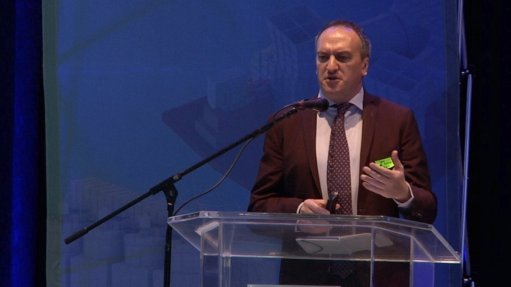
Every Friday morning, SAfm's AMLive's radio anchor Tim Modise speaks to Martin Creamer, publishing editor of Engineering News and Mining Weekly. Reported here is this Friday's At the Coalface transcript:
Modise: The Department of Science and Technology looking in to bringing back South Africa's space rocket launching capability.
Creamer: We used to have a space rocket launcher capability at the Overberg in the Cape, but when we signed, as a country, the nuclear non-proliferation treaty, we mothballed that, because it was intended for military and weapons use.
Now Science and Technology Minister Naledi Pandor says that we don't have to use it for military use, but lets have a look at it and see if we can demothball it and whether we can get back to having this capability.
As we know we have got our own satellite in space, that satellite was designed and manufactured in South Africa and the State owns it.
There was a business case for that because instead of paying for the images at a rate of about R60-million a year this imagery is now done by ourselves at a much lower cost.
They are looking for a business case now to see if there is also a possibility of demothballing what was a capability here rocket launching.
A lot of people look at it with scepticism because it is going to be very expensive, but if there is a business case there I see no harm in looking at it and the Minister is doing that.
Modise: Something new and very exciting, it appears, is the air traffic tracking system and South Africa one of the first countries in the world to introduce this new state-of-the-art tracking system at its airport.
Creamer: That is right, we have OR Tambo in Johannesburg and Cape Town International Airport with a multilatiration radio tracking system, which means that it can track the position, height, speed and direction of aircraft.
It is also part of an upgrade that we are doing in South Africa and possibly has regional implications, because in theory, you could actually track aircraft movement in the whole of Sub-Saharan Africa from one centre using this technology which is so advanced.
The only sticking point is that many countries in Africa use their aviation revenue to put into the general coffers so they see it as a revenue stream and that would have to be replaced.
In our region here, the Southern Africa Development Communities are actually looking seriously at creating a regional hub where you actually get the tracking and positioning of all the aircraft in a regional skyspace. It can be controlled from one centre which can lower your costs and increase you safety.
We see that safety already in Africa is no longer the most unsafe airspace in the world as it used to be, it is uplifting itself. With technology like this multilateration it is seen as something that can actually lower coast and increase safety.
Modise: Just as a matter of interest, does this mean that at least over the South African airspace that through this technology you can tell how many aircraft are out there in the airspace and the heights and so on.
Creamer: In this case, what they do is over a 51 m2 they put up four antenna and over that footprint they can check on their position, height, speed and direction of all aircrafts. So, of course, if they go regional there would probably be other implications.
Modise: The South African Army embarking on a programme of bridge building in the poor areas of the Eastern Cape.
Creamer: It is all about South Africa being a developmental State.
The Minister of Defence Lindiwe Sisulu said that we must introduce this concept of the developmental state even into the army. So, if you have got a situation that the army does have of a corps of engineers, why not use them when there are far-flung areas that need bridges for instance.
They have started with this idea of a tactical bridge in Xume in Queensland in the Eastern Cape, where they can come in and put in this hand assembled bridge in a week. That means a lot to the local people, because there has been a tradition in this area of this river swelling during the rain periods and people can't get to school or clinics.
Now, they are able to go over this bridge and it is a substantial bridge, they can take the military army trucks and everything. It is perfect for this regional areas and it is making use of existing resources that we have that usually have to be combat ready and that is why this has been the sticky point in the past.
Now we see them go in and build this bridge and it happens in other countries. Brazil are very active, their engineer corps is part of their army.
The Brazillian army is six times bigger then ours in terms of permanent force, but they actually go in and build permanent bridges and they compete against the private sector.
We don't have to do that here, but there is a lot of opportunity and, of course, the defence force engineers corps, would be remunerated for their time and their resources that they put in.
I don't know if they are going to make a profit, the jury is still out on that, but it is all part of the Minister of Defence Lindiwe Sisulu migrating the concept of a developmental state into the defence force.
Modise: Of course, giving the defence force some sort of practice run of sorts in the process. Thanks very much. Martin Creamer is publishing editor of Engineering News and Mining Weekly, he'll be back with us at the same time next week.
To subscribe to Engineering News's print magazine email subscriptions@creamermedia.co.za or buy now.


lr1_2.gif)