Creamer Media’s Engineering News Online
Advanced Search


We have detected that the browser you are using is no longer supported. As a result, some content may not display correctly.
We suggest that you upgrade to the latest version of any of the following browsers:
         
close notification
powered by
GOLD 1389.29 $/ozChange: 14.20
PLATINUM 1457.50 $/ozChange: -15.00
R/$ exchange 9.55Change: 0.00
R/€ exchange 12.35Change: -0.02


22/07/2011 (On-The-Air)
 
22nd July 2011
TEXT SIZE
Text Smaller Disabled Text Bigger
 

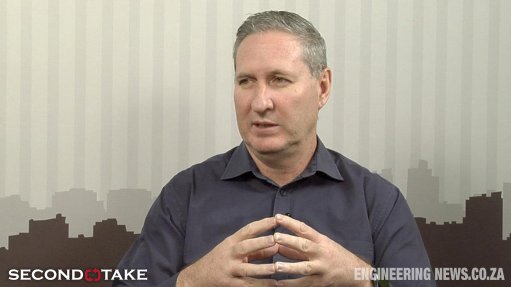
Every Friday morning, SAfm’s AMLive’s radio anchor Gillian De Gouveia speaks to Martin Creamer, publishing editor of Engineering News and Mining Weekly. Reported here is this Friday’s At the Coalface transcript:

De Gouveia: You have some news for us regarding a waste dump in Limpopo that is being turned into a perspective treasure trove.

Creamer: We have this situation where magnetite has been building up over decades at Palabora Mining where they mine copper. This contains 57 % iron. Metallurgists have gone in year after year to try and work out how they are going to turn this to account.

Now we have a bunch of entrepreneurs going in there and cracking the code. I actually saw the product coming off their production line this week at their pilot experimental plant. We have turned what is a waste product, so you’ve got an environmental benefit into coal briquette iron of high value.

There is so much of this waste laying around the world. It is not just Palabora, next door as Foskor there is a lot of this waste and all over the world in West Africa, Brazil and in Canada. So, we now have a situation where there is a global opportunity for this company, which is the Iron Mineral Beneficiation Services.

Already the Russians have rushed in and Severstal has bought a share of this, because Severstal wants to be involved in this metallic iron as they call it around the world. They have already got a royalty situation and they’ve introduced this South African company already to an opportunity in Canada where it looks like an even bigger 2-million ton plant is going to eventuate.

This goes into the electric arc furnace method of making steel, which is the preferred method at the moment. The blast furnace method has been outlawed in Europe and US only in China are new blast furnace situations going that are so dependent on iron-ore.

This is at an advance, because it could introduce what we call the mini-mill that we have been looking for where you don’t have this huge investment that you can actually have steel emanating from much smaller mills with much smaller investment. So, it could open a new way of steel making.

De Gouveia: Onto some other interesting news, Brazil and South Africa teaming up to develop a surface-to-air missile. Tell us a bit about that.

Creamer: There is formal talks going on now between the Brazilian Navy and the South Africa around the surface-to-air missile possibility. The Umkhonto, meaning spear, which we already use on our own naval vessels, but we use the infra-red guidance type. What the Brazilians are looking for really is what we now as Umkhonto-R, which is the radar homing type.

We are in a situation in South Africa where the Department of Defence has been keeping the concept of this Umkhonto-R going along, but not actually funding it for development.

Now the Brazilians are coming in and saying that they can codevelop this to develop the Umkhonto-R and then put it on new frigates, which we are planning to buy. Of course, they also had a great deal with us with the A-Darter programme, which is an air-to-air missile that was very successful, so this is opening the way.

They are looking to possibility also a surface-to-air missile in the A-Darter range, because we know that they’ve got the 2014 Fifa World Cup coming up. They have also got the 2016 Olympics and they want to firm up their air cover.

De Gouveia: You mentioned A-Darter, I think the amount of $130-million was bandied about at the time and it was said that the first 100 to 200 units would be sold internationally. Do they have that same vision for the new project that they would sell the Umkhonto internationally?

Creamer: Typically in defence keeps everything close to their chest, they take a long a long time to gestate, so you have got to look from a distance, but the possibilities are their. We see that Denel which is behind all this, South Africa’s State-owned corporation, has already got Denel doBrazil.

De Gouveia: The Canada-listed Rockwell Diamonds is going all out to boost its South African ownership. Now apparently only 8% of its shareholders are in South Africa. Is that why?

Creamer: That is correct. You have a situation now where companies mining in South Africa, the resources in South Africa, these diamonds in South Africa, they are beneficiating themselves here, but they have got to go to Canada to get money.

Our Johannesburg Stock Exchange investors are very risk averse. So they don’t go into the situation where their could be risk but also high reward. So, people have to go to Canada. The Canadians, who are thousands of kilometres away see fit to invest as they have done in this Rockwell Diamonds. If you go to Toronto and you look at some of those skyscrapers, many of them have been built on a profit of mining, why?

Because the government has come to the party in Canada where they give a flow-through scheme. There is an incentive for exploration activities which gives people confidence to go into these ventures, many of which really proof greatly beneficial. We don’t have that.

We did go to the government in South Africa as the investor community and say look, can’t we have a flow-through type scheme. We saw it coming through the budget saying yes they are going to investigate this. They finally said that we will have something better in South Africa then a flow-through scheme. They Gazette it and it is so parsimonious, so stingy beyond believe that it hasn’t had one uptake, which shows you it is just a non-starter.

So, the Minister of Finance Pravin Gordhan has said that he is willing to take in new submissions to see how we can do better in this, but in the meantime, you have got Rockwell Diamonds listed on the Johannesburg Stock Exchange, determined to move that 8% South Africa ownership to a far greater level. It is now lead by James Campbell the new CEO, who comes from Botswana where he was with African Diamonds.

He lifted the percentage of African Diamonds ownership to 20% in Botswana. You see in neighbouring Botswana, investors coming in and they are listing on the Botswana Stock Exchange. We do black-economic empowerment here, they do very broad based encouragement of people to get onto the stock exchange there, so all the pension funds, provident funds and retail investors can get in on the ground floor. This is sort of concept we have to regenerate in South Africa.

De Gouveia: If Rockwell Diamonds does manage to boost its South African ownership is that going to be a mutually beneficial relationship?

Creamer: Potentially mutual beneficiation. We now have got our resources in which we as investors aren’t having a share in. Even neighbouring Botswana sees the advantage of having a share in their own resources. Why should foreigners have the full share of our resources come in on the ground floor and as these things develop get all the benefit and we can see it in Toronto when we visit there.

De Gouveia: Lets hope so, with everything else from fuel to interest rates raising perhaps a bit of good news for the consumer. Thanks very much. Martin Creamer is publishing editor of Engineering News and Mining Weekly, he’ll be back with us at the same time next week.


To subscribe to Engineering News's print magazine email subscriptions@creamermedia.co.za or buy now.

FULL Access to Mining Weekly and Engineering News - Subscribe Now!
Subscribe Now Login


safm_220711
GET SELECTED AUDIOCLIP
Embed
This article's audio Download (8.01mb)